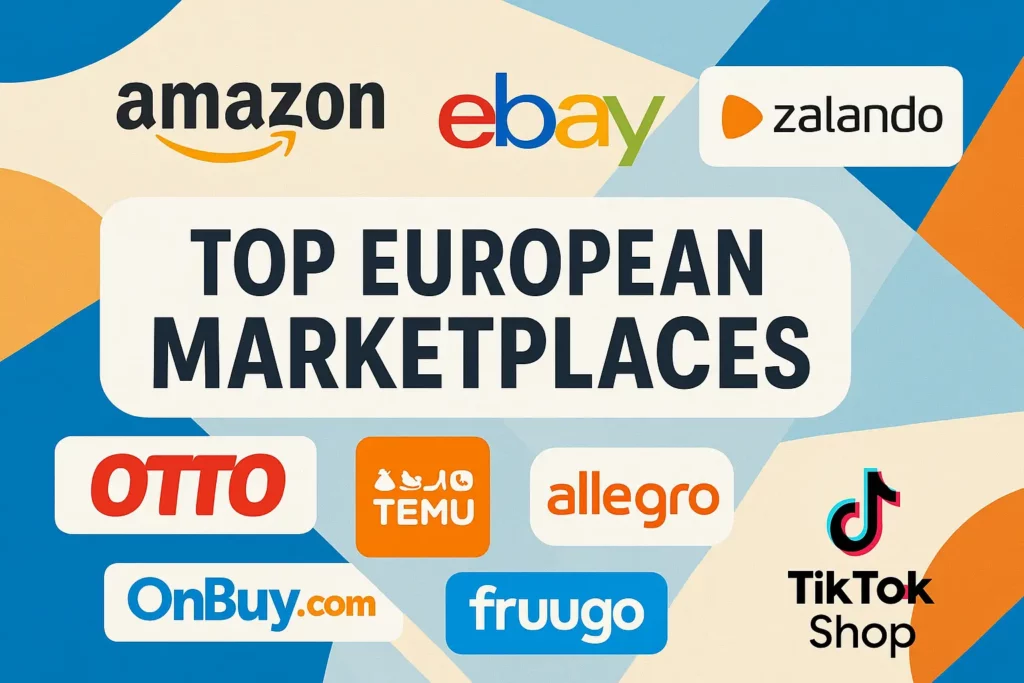
For ambitious UK sellers, expanding into Europe represents one of the most significant growth opportunities available today. While it might seem complex at first, choosing the right platform can unlock access to a diverse and affluent market of over 450 million potential customers. The European e-commerce market is projected to reach nearly US$900 billion by 2028, making it a critical arena for any brand serious about growth [2]. The key is knowing where to start. With a landscape full of diverse European online marketplaces, finding the perfect fit for your products is crucial for a successful international launch.
This comprehensive guide is designed to provide that clarity and understanding of how you can leverage Top European online Marketplaces for Multi-Channel Ecommerce growth. We will explore the top marketplaces in Europe, offering deep dives into their strengths, seller requirements, and target audiences. You’ll learn the practical steps for navigating cross border e-commerce, gain a realistic understanding of fees and logistics, and discover why a multi-channel ecommerce strategy is more important than ever for building a resilient business.
A Snapshot of Europe’s E-commerce Powerhouses
Before choosing a marketplace, it’s helpful to understand the key markets. Germany stands as Europe’s largest e-commerce market, with revenues of US$148 billion in 2022. It is followed by the UK, France, Spain, and Italy, which together represent the five largest and most lucrative markets on the continent. A successful European strategy often starts by targeting one or more of these powerful economies [2].
Top Marketplaces in Europe for Sellers Expanding in 2025
Your European journey should begin with platforms that command significant traffic and consumer trust. These established players offer the quickest route to visibility and sales, serving as powerful springboards for your brand.
1. Amazon (Pan-European)
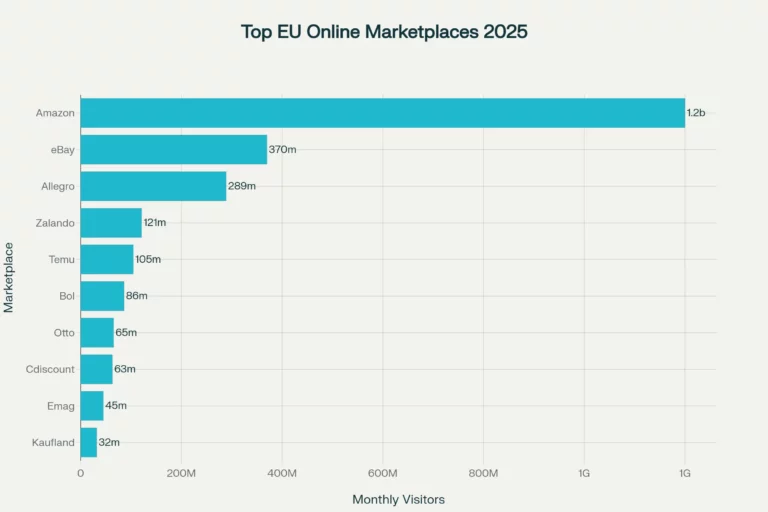
Amazon is the undisputed leader in Western Europe, operating dedicated marketplaces in Germany, France, Italy, Spain, the Netherlands, Sweden, Poland, and Belgium. With a staggering 1.2 billion monthly visitors across its five largest European sites alone, its scale is unmatched [2].
- Key Statistics: Amazon is the #1 marketplace in Germany, the UK, France, Italy, and Spain. More than 86,000 third-party sellers are active on its European platforms, with over 2,700 products sold every minute [2].
- Strengths for UK Sellers: The familiar Seller Central interface and Amazon’s world-class logistics network, including the European Fulfilment Network (EFN) and Pan-European FBA, make it the most logical first step for many. These programs handle storage, delivery, and customer service, significantly lowering the operational barrier to entry.
- Ideal Seller Profile: Amazon is ideal for almost any seller with a diverse product range. It is particularly powerful for brands that can compete on price, delivery speed, and customer service, and are prepared to invest in Amazon Advertising (PPC) to gain initial visibility.
2. eBay (pan-European)
eBay remains one of the top marketplaces in Europe, standing out as a trusted ecommerce marketplace with a strong legacy and continued relevance. It operates localized platforms across 14 European countries (excluding the UK), attracting around 367 million monthly visits from Europe alone [2], about 22% of eBay’s global traffic outside the USA (Webretailer). This reach positions eBay firmly among the most established European online marketplaces.
- Key Statistics: eBay reported roughly 6 million active sellers worldwide in 2024, with Germany and the UK ranking among its largest seller bases (Red Stag Fulfillment). A recent eBay report found that 97% of EU small-business sellers export, compared to just 8% of traditional businesses, with an average of 18 international markets per seller. This makes eBay a leading force in enabling cross border e-commerce (eBay Inc.).
- Strengths for Sellers: eBay’s appeal lies in its consistency across marketplaces in Europe, offering familiar tools, feedback systems, and streamlined operations. Its platform simplifies international expansion, allowing SMEs to sell in multiple countries without creating entirely new storefronts. This seller-friendly model makes eBay particularly valuable for businesses embracing multi-channel ecommerce, where sellers combine eBay with Amazon, Etsy, or emerging European platforms.
- Ideal Seller Profile: eBay is best suited to SMEs, niche product sellers, and entrepreneurs looking to expand quickly across borders. With its flexibility in listing both new and second-hand goods, it enables sellers to capture diverse buyer segments. Those who prioritize efficient shipping and customer trust will find eBay an accessible and reliable ecommerce marketplace for scaling across European online marketplaces..
3. Zalando (Pan-European)
Zalando is Europe’s premier online destination for fashion, footwear, and beauty, operating in over 25 countries and serving around 50 million active customers.
- Key Statistics: Zalando attracts more than 121 million visitors each month and is predicted to reach a Gross Merchandise Value (GMV) of €30 billion in 2025 [2].
- Strengths for UK Sellers: Its curated Partner Program provides a premium, brand-safe environment, shielding sellers from the intense price competition common on other platforms. Access to Zalando Fulfilment Solutions (ZFS) offers tailored logistics for fashion products, including handling complex returns.
- Ideal Seller Profile: Zalando is best for established and emerging fashion brands with a strong identity and high-quality product imagery. You must apply to its Partner Program and meet its strict quality and style requirements to be accepted.
4. Otto (Germany)
A German retail institution, Otto has successfully transformed from a mail-order giant into the country’s second-largest online retailer, with 66 million monthly visitors [2].
- Key Statistics: Otto has over 11 million registered, active users and processes up to 10 orders per second [2].
- Strengths for UK Sellers: Otto offers access to a loyal, high-spending German customer base that trusts the brand implicitly. As a curated marketplace, it features less direct competition from international sellers compared to Amazon, allowing for better brand positioning.
- Ideal Seller Profile: Brands in the fashion, furniture, homeware, and electronics categories with a reputation for quality. Sellers must be registered as a German business and provide German-language customer service to qualify.
5. Allegro (Poland & Eastern Europe)
Allegro is the dominant force in Poland’s e-commerce market, boasting over 20 million active buyers and 160,000 merchants. It is more popular than Amazon in its home market and is rapidly expanding into the Czech Republic, Slovakia, and beyond [2].
- Key Statistics: Allegro attracts about 289 million global visitors monthly, with approximately 1 in 10 making a purchase.
- Strengths for UK Sellers: It provides an essential gateway to the fast-growing markets of Central and Eastern Europe, offering a significant first-mover advantage. The platform provides strong support with its own payment service (Allegro Pay) and a convenient network of pickup points.
- Ideal Seller Profile: Any seller looking to tap into the Polish market. It is a generalist marketplace with strong categories in automotive, electronics, fashion, and home & garden.
European Online Marketplaces: Which Platforms Drive the Highest ROI?
Maximising your Return on Investment (ROI) isn’t just about the platform with the lowest fees; it’s about finding the most profitable audience for your products.
- For Maximum Reach (High Volume): Platforms like Amazon and eBay offer unparalleled traffic, but competition is fierce. This can compress margins due to price wars and the necessity of ad spend. Here, ROI is driven by operational excellence and economies of scale.
- For Niche Targeting (High Margin): Specialised marketplaces in Europe like Zalando (fashion) or ManoMano (DIY) attract pre-qualified buyers with strong purchase intent. This leads to higher conversion rates and allows for full-price selling, often resulting in a superior ROI for sellers in those specific categories [2].
- For Regional Dominance (High Engagement): A “local hero” platform like Allegro in Poland can offer the best ROI for that specific market. Due to deep customer loyalty and less saturation from global sellers, it’s often easier and cheaper to acquire customers.
Cross-Border E-commerce in Europe: How Sellers Can Scale Faster
Successfully managing cross border e-commerce is the key to scaling. For UK sellers, this means handling logistics and customs efficiently. You’ll need an EU EORI number for your goods to clear customs, and it’s crucial to manage VAT properly using the Import One-Stop Shop (IOSS) scheme for consignments under €150. Beyond these initial steps, sellers must also be aware of EU-wide product compliance.
Under the General Product Safety Regulation (GPSR), most products sold in the EU [1] now require a designated ‘Responsible Person’ based in the EU. Furthermore, if selling into Germany, you must comply with the LUCID Packaging Act by registering your packaging and paying a recycling fee. For electronics, the WEEE directive requires you to manage the disposal and recycling of your products.
Country-Specific Marketplaces in Europe Sellers Shouldn’t Ignore
While pan-European platforms offer broad reach, local champions provide deep market penetration and access to highly loyal customer bases.
- Cdiscount (France): As France’s leading domestic marketplace, Cdiscount has approximately 86 million customers which includes 19 million unique monthly users [2]. It is known for its focus on value and is a powerhouse for electronics, home goods, and toys.
- Bol.com (Netherlands & Belgium): In the Benelux region, Bol.com is the dominant force, outperforming Amazon with 13 million customers and 86.2 million monthly visitors [2].
- eMAG (Romania): For sellers looking toward Eastern Europe, eMAG is the largest online retailer in Romania, with over 45 million monthly visitors, and is rapidly growing in Bulgaria and Hungary [2].
Multi-Channel Ecommerce: Why Listing on Multiple Marketplaces Wins in 2025
Relying on a single marketplace is a high-risk strategy. A multi-channel ecommerce approach is the best way to build a resilient and scalable business [3].
- Risk Diversification: Spreading your presence across multiple marketplaces in Europe protects your revenue from a single platform’s algorithm changes, fee hikes, or an unexpected account suspension.
- Wider Audience Reach: Different platforms attract different demographics. Being on both a generalist and a specialist site help you capture a broader market.
- Increased Brand Visibility: A central system to sync stock levels across all platforms is essential to prevent overselling.
European Marketplace Fees, Logistics, and Seller Policies
Before you commit to a platform, you need a clear picture of the costs and operational rules.
You can also expect fulfilment fees if you use the marketplace’s logistics service (like FBA) and must adhere to strict seller policies, including providing local-language customer support and a clear returns policy of at least 14 days.
Emerging Marketplaces in Europe That Offer Early-Mover Advantage
Getting in early on a rising platform can mean less competition and a chance to establish your brand.
Temu is one of the fast-rising platforms among the top marketplaces in Europe. Known for its mobile-first experience, Temu has rapidly gained traction in markets like France and the UK [2], though calling it a “top five retailer” is not officially confirmed. It is particularly well-suited for sellers offering low-cost, high-volume products. For brands looking to explore European online marketplaces, Temu presents a strong early-mover opportunity in the fast-growing segment of multi-channel ecommerce.
OnBuy is a UK-based ecommerce marketplace that is expanding aggressively across Europe. It operates with a transparent, non-competing model, supporting sellers without selling its own inventory. OnBuy’s strategy positions it as a noteworthy option among marketplaces in Europe, especially for brands seeking to diversify into multi-channel ecommerce and benefit from early entry into emerging markets.
Fruugo is designed for seamless cross border e-commerce, making it one of the standout European online marketplaces for international sellers. The platform automatically localizes listings for over 40 countries, translating languages and currencies to simplify global selling. Fruugo is particularly suitable for sellers aiming to scale across multiple countries while maintaining a consistent ecommerce marketplace presence.
Kaufland.de is a rapidly expanding marketplace in Germany that combines food and non-food categories. As part of a major supermarket chain, it has become an attractive option for brands entering marketplaces in Europe, with plans to expand into Poland, Austria, and Italy. Kaufland.de is especially relevant for sellers seeking a multi-channel ecommerce approach to reach both national and cross border e-commerce customers.
TikTok Shop represents the rise of social commerce and is increasingly considered among the top marketplaces in Europe for trend-driven products. With strong adoption in Germany, France, and Italy, TikTok Shop allows sellers to integrate entertainment and commerce, creating a dynamic channel within the broader ecosystem of European online marketplaces. It is ideal for sellers exploring multi-channel ecommerce strategies and targeting impulse-driven, fast-moving categories like fashion, beauty, and novelty products.
Marketplace | Key Focus / Strength | Geographic Reach | Seller Advantage | Best For |
Temu | Mobile-first, low-cost, high-volume products | Rapid growth in France & UK | Early-mover with less competition | Sellers offering budget-friendly items |
OnBuy | Transparent, non-competing marketplace (doesn’t sell its own products) | UK-based, expanding across Europe | Seller-first model, early entry opportunity | Brands seeking multi-channel diversification |
Fruugo | Cross-border e-commerce with auto-localization (languages & currencies) | 40+ countries worldwide | Simplifies global selling | Sellers scaling internationally |
Kaufland.de | Backed by supermarket chain, mix of food & non-food | Strong in Germany, expanding to Poland, Austria & Italy | National & cross-border reach | Brands entering Central European markets |
TikTok Shop | Social commerce integrating shopping with content | Strong adoption in Germany, France & Italy | Appeals to trend-driven consumers | Fast-moving categories (fashion, beauty, novelty) |
How to Make Your Listings SERP-Friendly on European Marketplaces
Success depends on optimizing your product listings for both the marketplace’s internal search and external ones like Google.
- Conduct Localised Keyword Research: Use tools to find the search terms customers in Germany, France, or Spain actually use.
- Optimize Product Titles: Structure them logically: [Brand] + [Product Name] + [Key Feature] + [Size/Color].
- Write Rich, Informative Descriptions: Use bullet points for benefits and detailed paragraphs to answer common questions. Write for people first.
- Use High-Quality Images with Alt-Text: Multiple, high-resolution images are essential. When allowed, fill in the “alt-text” with a descriptive phrase.
Choosing the Best European Marketplace for Your Products in 2025
To find the right starting point, ask yourself these questions:
- What is my product category? If you sell fashion, target Zalando. For DIY, look at ManoMano. For general goods, start with Amazon.
- Who is my target customer? Are they looking for premium brands or the best possible price? Choose a platform whose audience aligns with your products.
- Which country do I want to target first? Germany is Europe’s largest ecommerce marketplace, making it a great place to start [2].
- How much am I willing to invest? Curated platforms like Zalando may require more initial effort, while open platforms like eBay allow you to test the waters with less commitment.
Marketing and Gaining Traction on a New Marketplace
Simply listing your products isn’t enough; you need a launch strategy to get your first sales and reviews.
- Utilize Marketplace-Specific PPC: Most major platforms have their own advertising systems, like Amazon Advertising, Allegro Ads, and Cdiscount Ads. A small, targeted budget can dramatically increase your visibility in the crucial first few weeks.
- Leverage Initial Promotions: Offering a launch discount or participating in platform-specific sales events (like Cdiscount’s “French Days”) can attract early buyers.
- Focus on a Flawless Early Customer Experience: Your first 10-20 orders are critical. Ship them perfectly, respond to any questions quickly (in the local language!), and encourage reviews. Positive early feedback is the most powerful marketing tool on any marketplace.
Conclusion
Expanding your business into Europe is a powerful strategy for growth in 2025 and beyond. Success requires a thoughtful approach that starts with choosing the right platform for your products. Focus on mastering localisation, compliance, and logistics for that market [3]. From there, you can build a robust, multi-channel ecommerce presence across the top marketplaces in Europe that will make your brand a true European player.
FAQs
What are the top marketplaces in Europe in 2025?
The leading platforms are Amazon, eBay, Zalando, Otto, Allegro, Cdiscount, Bol.com, and eMAG [2]. Amazon dominates Western Europe, while regional players like Allegro in Poland and Cdiscount in France attract millions of loyal buyers. These top marketplaces in Europe provide strong opportunities for UK sellers expanding abroad.
Which European online marketplaces are best for UK sellers?
For maximum reach, Amazon and eBay are the strongest European online marketplaces [4]. For niche categories, Zalando (fashion) or ManoMano (DIY) work best. If you’re targeting specific countries, consider Cdiscount (France), Bol.com (Benelux), or eMAG (Romania) [2].
What makes marketplaces in Europe different from the UK?
Marketplaces in Europe often have strict compliance requirements such as VAT registration, the EU’s Import One-Stop Shop (IOSS), and local-language customer service. Germany, France, and Poland have highly localized platforms like Otto and Allegro, which don’t exist in the UK.
How does cross border e-commerce work in Europe?
Cross border e-commerce allows UK sellers to list on European platforms and ship internationally. Sellers must register for an EU EORI number, handle VAT via IOSS, and comply with EU safety and packaging regulations [1]. Using fulfilment solutions like Amazon’s Pan-EU FBA simplifies cross-border logistics.
Which ecommerce marketplace has the most traffic in Europe?
Amazon leads all ecommerce marketplaces with over 1.2 billion monthly visits across Europe. eBay and Allegro also attract hundreds of millions of visits monthly, while Zalando dominates the fashion sector with over 120 million visits [2].
Why is multi-channel ecommerce important in 2025?
Relying on one platform is risky. A multi-channel ecommerce approach allows sellers to list on Amazon, eBay, Zalando, and emerging platforms like OnBuy, Fruugo, or TikTok Shop. This diversifies revenue, increases visibility, and reduces dependence on a single platform [3].
Which local marketplaces in Europe offer high ROI for sellers?
“Local hero” platforms such as Allegro in Poland, Cdiscount in France, and Bol.com in Benelux often deliver strong ROI due to loyal customer bases, lower competition, and region-specific trust compared to global platforms [2].
Citations
- Lovat Compliance. (2024). 6 main requirements to be ready for GPSR. Retrieved from https://vatcompliance.co./
- (2025). The top 14 European marketplaces in 2025. Retrieved from www.icmagroup.org .
- European Commission. (2024). Communication on an EU toolbox for safe and sustainable e-commerce. Retrieved from nortonrosefulbright.com .
- (2025). Top 20 ecommerce marketplaces in the world in 2025. Retrieved from www.channelengine.com