Picture walking into a shop where nothing is quite where you expect it to be. You head for what should be a quick grab, only to find yourself checking three different aisles before giving up and asking someone for help. It’s frustrating, but in a shop it costs you a few minutes.
In a warehouse, the same confusion plays out hundreds of times a day, and the impact is far bigger. This is where warehouse rack labeling makes a real difference. Clear, consistent rack labels remove uncertainty and help teams move with confidence rather than hesitation. For ecommerce operations shipping orders daily across the world effective rack labeling is one of the most practical ways to improve order picking efficiency without increasing headcount or expanding warehouse space.
Why Warehouse Organization Breaks Down as Order Volume Grows
In the early days, most ecommerce teams rely on familiarity. Stock stays roughly where everyone expects it to be, and small issues are easy to work around. As order volumes grow, especially with next-day delivery expectations becoming the norm, that informal approach begins to show its limits. What happens is picking gets slow, mistakes become more frequent, and the warehouse feels busier even when staffing levels haven’t changed.
In many cases, unclear rack identification is the underlying issue. When locations aren’t obvious, teams fall back on memory. That works until a key team member is away or seasonal staff are brought in. At that point, “we know where things are” is no longer enough to keep fulfilment running smoothly.
UK logistics bodies frequently highlight this challenge. Organisations such as the Chartered Institute of Logistics and Transport (CILT UK) emphasise the role of structured warehouse processes in supporting reliable, scalable fulfilment as volumes increase.
Rack Labeling often confused with product labeling
Rack labeling is often confused with product labeling, but the two serve different purposes. Product labels identify what an item is. Rack labels identify where that item belongs within the warehouse layout.
In a warehouse for ecommerce, racks act as fixed reference points. Shelves, bins, and stock levels may change, but rack locations usually remain constant. Clear rack identification comes in handy for both beginners and experienced pickers.
A well-designed rack labeling system creates consistency across people and systems. When everyone speaks the same “location language,” errors reduce and day-to-day operations become far more predictable and faster.
How Warehouse Racks Fit into a Complete Location System
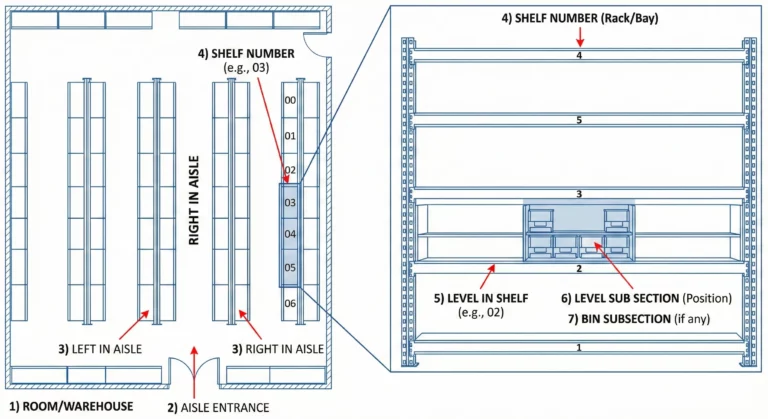
Most organised warehouses follow a simple hierarchy:
warehouse, aisle, side (left or right), rack, shelf, and bin
Each layer narrows the location until a picker knows exactly where to stand. Rack labels sit at the centre of this structure. They connect high-level navigation, such as aisles, to precise picking locations like shelves and bins. When rack identification is clear, the rest of the system works intuitively.
Common Rack Labeling Mistakes That Cause Disorganization
Many warehouses technically have warehouse rack labels, but not all labels support fast, accurate picking. Inconsistent numbering is a common issue, particularly in spaces that have evolved over time. When different zones follow different naming conventions, pickers are forced to interpret locations rather than simply follow them.
Poor visibility makes everything harder. Small labels, inconsistent placement, or labels hidden behind stock cause problems in real use. Skipping left-and-right aisle identification adds unnecessary guesswork, especially where racks face each other.
The most damaging mistake is misalignment between physical labels and digital records. When the warehouse floor and the WMS disagree, confidence in location data disappears and errors soon follow.
Practical Rack Labeling Ideas for Ecommerce Warehouses
Effective rack labeling doesn’t need to be complicated. Clear alphanumeric codes are usually the easiest to work with, both visually and verbally. Formats that combine aisle, rack, and level information scale well as operations grow.
Example of alphanumeric codes like A-01-03 (Aisle A, Rack 01, Level 03) keep big, bold fonts readable from afar.
Colour-coded zones can add another layer of clarity, particularly for fast-moving products. In busy ecommerce warehouses, this helps spread picking activity and reduce congestion during peak periods.
Placement matters just as much as naming. Rack labels should be visible from the aisle entrance, positioned consistently, and durable enough to handle daily wear. Planning for future growth, such as leaving gaps in numbering for new racks can prevent costly relabelling later.
Choosing a Rack Labeling Method That Fits Your Warehouse
Once the basics of rack labeling are in place, the next step is choosing a structure that fits how your warehouse operates. The most commonly used rack labeling methods in ecommerce warehouses include:
- Linear numbering, where racks are numbered in sequence across aisles. This approach works well in smaller or very simple layouts.
Example: Aisle 1 – Rack 05 – Level 02
- Zone-based rack labeling, where the warehouse is divided into clear zones and each zone contains its own aisles and racks. This is often the most practical option for growing ecommerce operations.
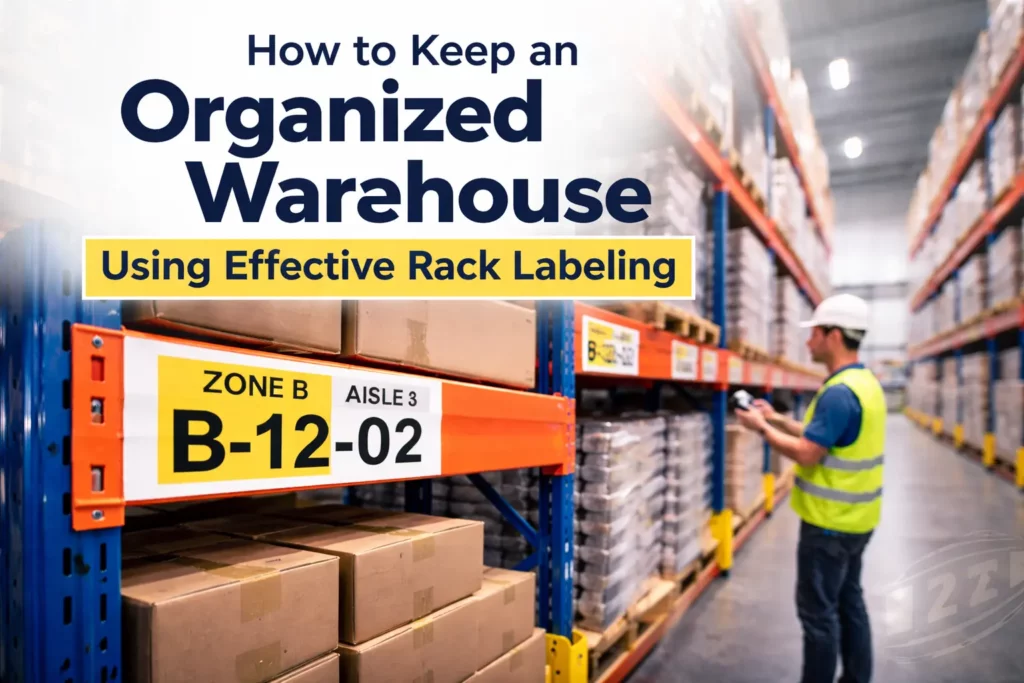
Example: Zone B – Aisle 3 – Rack 12 – Level 01
- Route-based or directional layouts, which follow a defined picking path through the warehouse. These can work in some environments but usually add unnecessary complexity.
Example: Pick Route 2 – Section C – Rack 08 – Level 03
Whichever method you choose, consistency matters far more than the format itself, once a structure is in place, sticking to it is what keeps the warehouse organised and scalable.
Aligning Rack Labels With Your Inventory or WMS System
Rack labels only really help when they match what you see in your inventory system or warehouse management system (WMS). If your system tells someone to go to one location, but the rack on the floor is labelled differently, it quickly causes confusion and slows everything down.
Keeping rack names the same in both the warehouse and your WMS makes picking much easier. One simple way to do this is to create rack labels using the same information you use in your inventory system. That way, everyone is looking at the same locations. When rack labels and system locations don’t match, even small change, like moving stock or adding a new shelf can turn into a bigger problem
How Intelligent Order Clustering Maximizes the Value of Warehouse Labeling
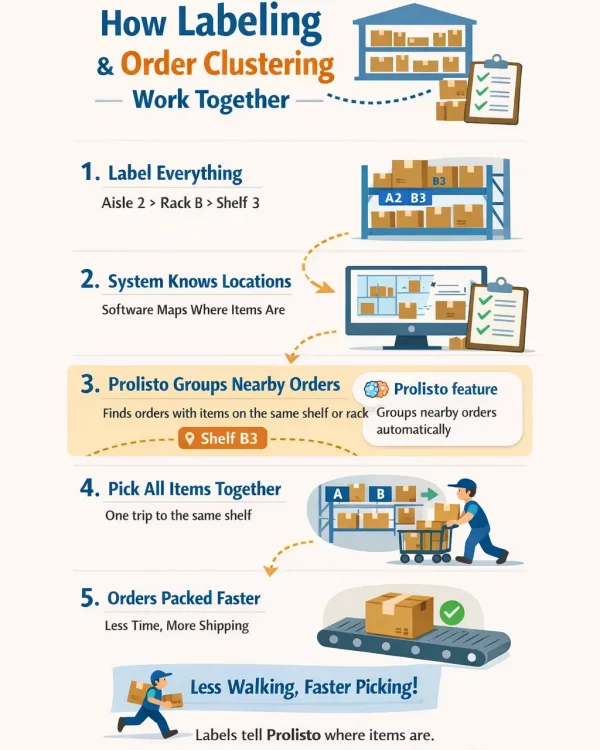
Clean rack and shelf labels are what make intelligent order clustering possible. Without accurate location data, software cannot optimise picking routes or group orders effectively.
Prolisto uses rack, shelf, and aisle information to understand where products are stored in relation to one another. Based on that data, it groups orders with items located close together are often on the same rack or shelf, so they can be picked in a single trip.
This approach reduces unnecessary walking and allows batch picking to happen naturally. In practice, organised labeling is what turns clustering from a theoretical feature into a real operational advantage.
What Changes on the Warehouse Floor After Clustering Is Applied
When clustering is applied on top of clear rack labeling, pick routes become shorter and more predictable. Aisles are less congested because pickers are no longer crossing the warehouse for single items.
Teams often notice that more orders are completed in the same amount of time, without the floor feeling rushed or chaotic. The overall pace becomes steadier, which is particularly important during busy fulfilment periods in the UK like Christmas or Black Friday.
A Simple Example of Rack Labeling Done Right
Midlands Apparel Seller
A UK apparel seller shipping from a Midlands warehouse used Prolisto alongside a newly standardised rack labeling system to change how picking was organised on the floor. Once rack and shelf locations were consistent, Prolisto began grouping orders that shared the same racks, which meant pickers often stayed in one aisle for longer instead of bouncing between zones.
What stood out wasn’t just speed, but how predictable the day became. Pickers worked efficiently, supervisors spent less time resolving questions, and late-afternoon pressure eased because work was distributed more evenly across the warehouse.
Final Thoughts: Organized Racks Are the Foundation of an Organized Warehouse
Most warehouses don’t become messy overnight. Things slip little by little, one unclear rack, a temporary label that never gets replaced, a shortcut that turns into a habit. That’s why warehouse rack labeling isn’t just housekeeping. It’s the quiet structure that keeps everything else working.
For sellers, staying organised usually starts with getting the basics right and then sticking to them. Good rack labeling won’t solve every challenge on its own, but without it, even the best processes struggle to hold up.
FAQs
What is warehouse rack labeling and why is it important?
Warehouse rack labeling is the practice of clearly identifying storage racks so products can be found quickly and consistently. It’s important because clear rack locations reduce searching time, picking errors, and confusion as order volumes grow.
What makes a good rack labeling system?
A good rack labeling system is simple, consistent, and easy to read from a distance. It should follow a clear structure, scale with growth, and match how the warehouse is actually used day to day.
How should a warehouse for ecommerce approach rack labeling?
A warehouse for ecommerce should use rack labeling that prioritizes speed, clarity, and repeatability. Zone-based layouts and bold, logical rack labels work well for high-volume picking and fast dispatch cycles.
Does rack labeling improve order picking efficiency?
Yes, clear rack labeling directly improves order picking efficiency by reducing hesitation, backtracking, and unnecessary walking. When locations are obvious, pickers can move faster and make fewer mistakes.
What should warehouse rack labels include?
Warehouse rack labels should clearly show the aisle, rack, and level in a consistent format. Labels should be visible, durable, and easy to understand at a glance to support fast and accurate picking.