EU Product Identifiers From 1 November 2026: What Sellers Shipping to the EU Need to Do
Author: Prolisto Team · Published: · 9 min read
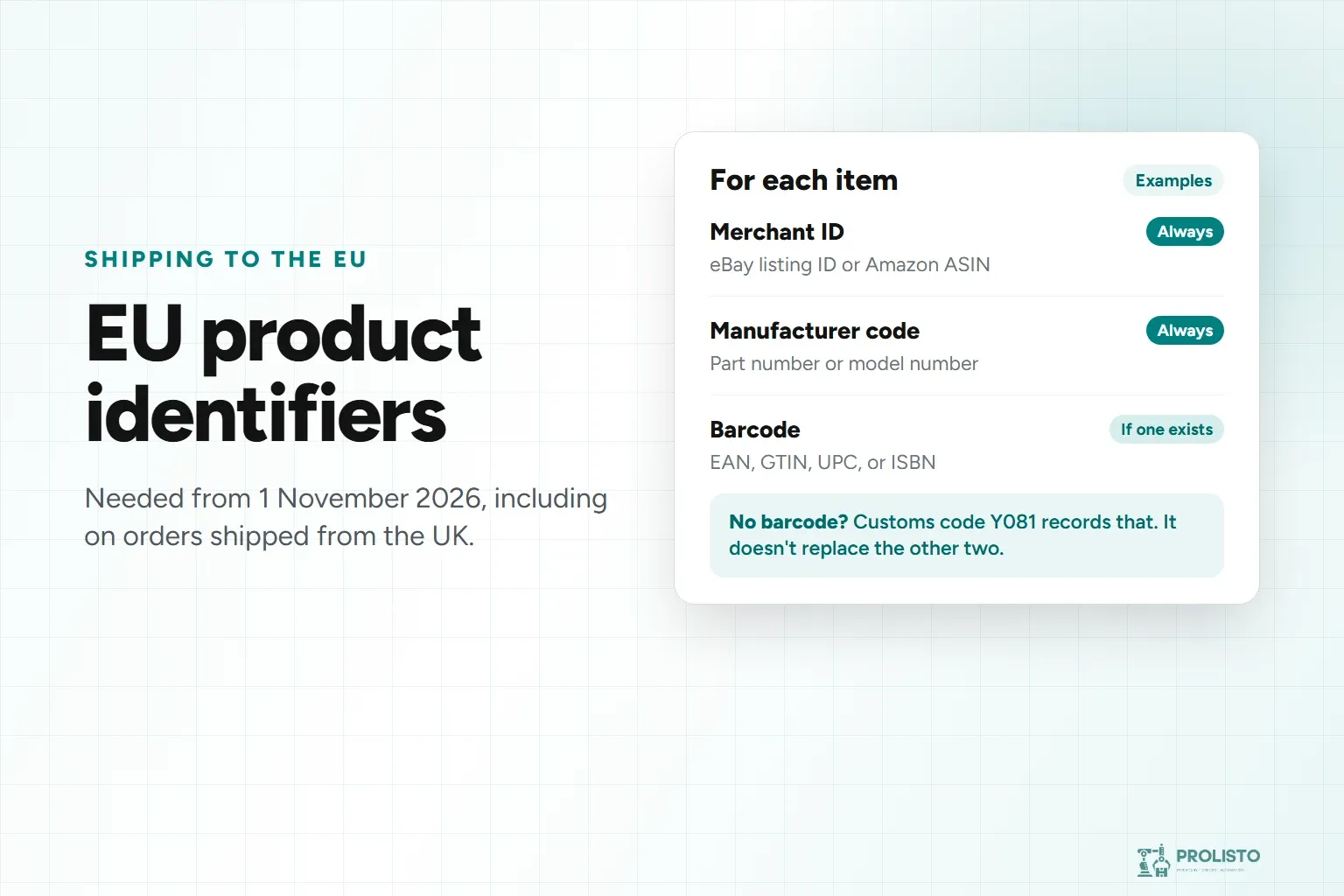
From 1 November 2026, EU product identifiers are mandatory for goods sold to EU consumers and shipped from outside the EU. That covers a UK seller posting an eBay or Amazon order to a buyer in Germany, France, or Ireland. If the codes don't reach customs, the parcel can be held or rejected at the border.
The requirement reaches sellers through their software. Your listing tool, shipping tool, or carrier connection has to pass the codes on, and it can only pass on what's stored against the product. Prolisto already sends them, and we'd encourage every seller shipping to the EU to check that their own setup does too. This guide explains the rule in plain English, what it means for used goods, and what to ask your software provider and carrier.
What changes on 1 November 2026?
Customs declarations for these parcels must now carry product codes for each item, so EU customs can identify and check products more easily. Sending the codes has been voluntary since 1 July 2026, and the European Commission's guidance says enforcement starts on 1 November.
| Order | Are identifiers needed? |
|---|---|
| Sold to an EU consumer, shipped from the UK or elsewhere outside the EU | Yes |
| Amazon seller-fulfilled order, shipped to the EU from outside the EU | Yes |
| eBay order you post to the EU with your own carrier | Yes |
| UK domestic order | No |
| Shipped from one EU country to another | No |
| Amazon FBA order | No, according to Amazon |
| Business-to-business sale | In principle no, according to the Commission |
What about the €150 limit? The Commission's guidance limits the rule to consignments worth up to €150, and says it's amending the legal text to make that clear. Not everyone describes it the same way: eBay's help page mentions €150, while eBay's announcement says the rule applies regardless of item value. Until that's settled, we'd send the identifiers on every EU order.
What are the three product identifiers?
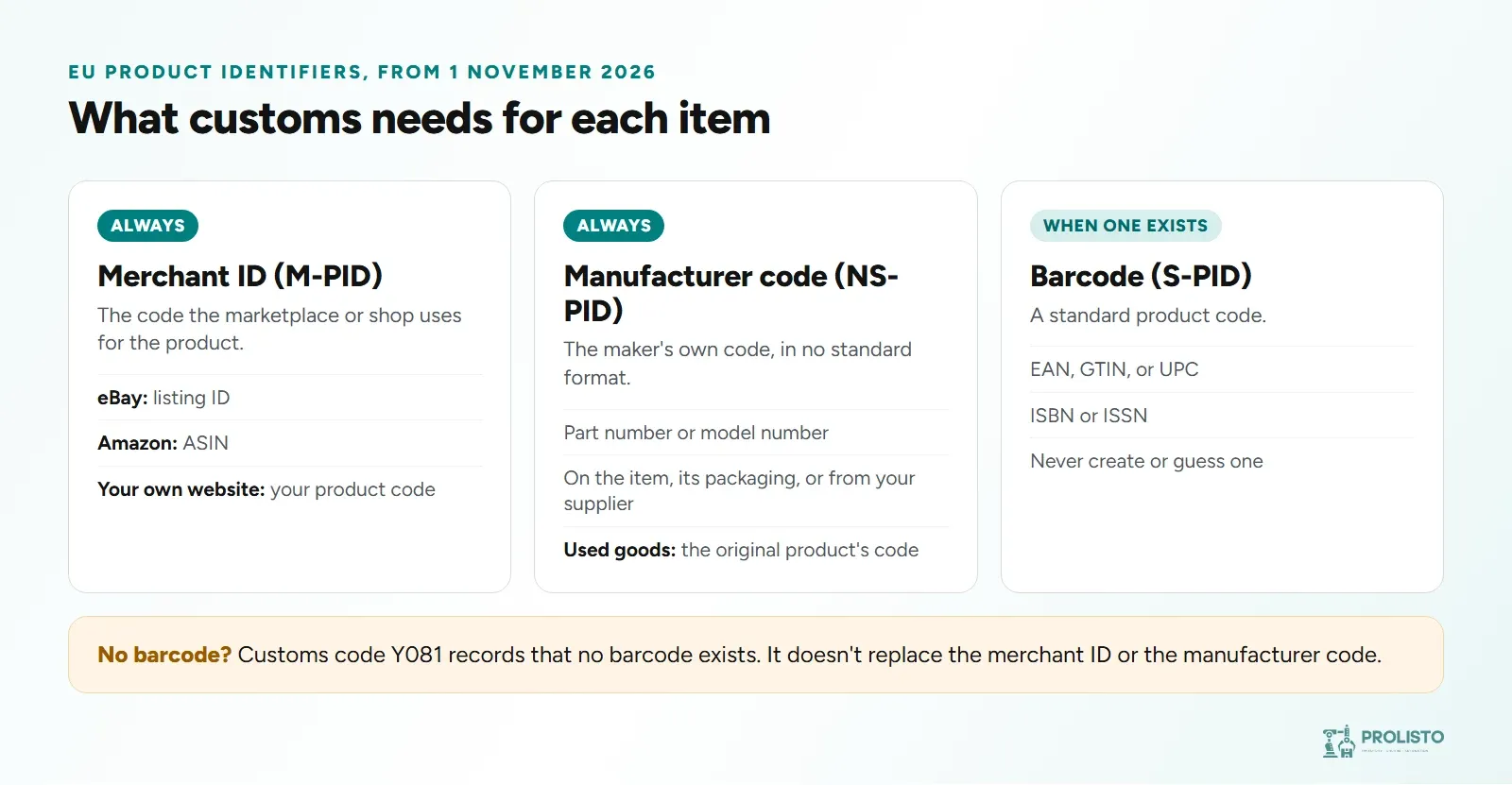
Each item needs a merchant ID and a manufacturer code. If the product has a barcode, that's needed as well. The Commission says the first two are needed "in all cases, with no exception".
| Identifier | What it is | Where to find it | When it's needed |
|---|---|---|---|
| Merchant ID (M-PID) | The code the marketplace or shop uses for the product | eBay: listing ID. Amazon: ASIN. Your own website: your product code | Always |
| Manufacturer code (NS-PID) | The maker's own code, in no standard format | Part number or model number, on the item, its packaging, or from your supplier | Always |
| Barcode (S-PID) | A standard product code | EAN, GTIN, UPC, ISBN, or ISSN | When one exists |
Three details catch sellers out:
- Your own SKU may not be the right merchant ID on a marketplace. The Commission describes this ID as the one used on the platform, not by individual sellers. Amazon tells developers not to reuse a seller SKU as a product identifier, and eBay uses the listing ID. A SKU fits best on your own website.
- A barcode can sometimes fill two fields. The Commission accepts this where the manufacturer uses its barcode as its own code, and both fields are still declared. Amazon asks for the barcode in the part number field when a product has neither a part number nor a model number.
- Own-brand products need your own code. If you make the product, or have it made under your name, you assign the manufacturer code. The Commission doesn't require a particular format.
What Y081 does, and what it doesn't
Y081 is a customs code that says no standardised barcode exists for the product. That's its whole job. It doesn't replace the merchant ID or the manufacturer code, so a parcel with a merchant ID and Y081 alone is still missing a required identifier.
Use it only when no barcode exists, not when you haven't looked for one. Carriers collect this in different ways, so ask yours how to record that a product has no barcode.
What happens if identifiers are missing?
The parcel can be delayed, held, or rejected. Exactly how it goes wrong depends on how you ship:
- At customs: the Commission's guidance says declarations can be held or rejected, and that providing incomplete or inaccurate data counts as an infringement.
- Amazon Buy Shipping: the label request can fail with an error if the part or model number is missing, so you find out before dispatch.
- Amazon orders sent through your own carrier connection: Amazon doesn't receive or check this data, and says a parcel with missing identifiers can be held or returned at the seller's cost.
- eBay orders sent with your own carrier: eBay warns of customs delays and delivery disruption.
Whoever lodges the declaration is responsible for its accuracy. That's often a carrier or customs agent, but if you use your own IOSS number, check what that means for you. Either way, they depend on the codes you give them.
What about used, vintage, and one-off items?
Second-hand goods aren't exempt. The Commission's guidance says that second-hand and refurbished goods must comply, and that "the PID of the original product shall be provided". This matters most if you sell used stock, because the codes are often missing from your records even though they're printed on the item.
Work through it in this order:
- Look at the item. Books, games, music, and film usually carry a barcode. Electronics and car parts often show a model or part number.
- Look up the original product. The manufacturer's website or a catalogue listing for the same product can give you the code. Only use it if it's for that exact product.
- Use Y081 only for a missing barcode. It still doesn't replace the manufacturer code.
- If there's truly no manufacturer code, ask your carrier before you ship. The guidance expects the manufacturer to assign one, which doesn't help when you've bought a 1970s lamp in a job lot. We haven't found official guidance that settles this case, and we won't guess at it here.
There's one narrow tolerance. Goods classified under certain commodity codes can declare the literal text "M-PID" and "NS-PID" instead of real codes. The Commission's list includes unprocessed agricultural goods, some handmade and artisanal goods, and antiques, collectibles, art, stamps, and coins. It depends on the item's commodity code, not on whether you'd call it vintage or handmade, so check the code first.
For personalised or print-on-demand goods, the Commission asks for the identifiers of the underlying product, such as the blank T-shirt.
Whatever you sell, don't invent a code. Amazon says not to submit placeholder values, and eBay says "Do not create or guess a GTIN, EAN, UPC, ISBN, or MPN."
What do Amazon and eBay sellers need to do?
Amazon sellers
The rule applies to seller-fulfilled orders, whichever way you buy the label.
- Labels through Amazon Buy Shipping: Amazon adds the ASIN, but not the part number, model number, or barcode from your listing. Your software has to send those with the label request.
- Labels through your own carrier account: your software has to add the ASIN, the part or model number, and any barcode to the customs data it sends to the carrier.
- FBA: not affected, according to Amazon.
- Easy Ship: a domestic service, so this rule doesn't come into it.
Amazon doesn't check the format of what you submit, and says you're responsible for its accuracy.
eBay sellers
- eBay International Shipping: eBay says it passes the identifiers from your listings to carriers automatically, so keep your item specifics accurate.
- Your own carrier: you have to supply the identifiers. The eBay listing ID is the merchant ID, and the manufacturer code usually comes from the MPN. eBay's advice for anyone using third-party software is to ask the carrier or software provider how the data is submitted.
Royal Mail users
Royal Mail's Click & Drop help centre says two product fields are required when posting e-commerce goods to the EU from 1 November 2026:
- Product SKU: Royal Mail asks for each one to be unique, up to 100 characters.
- Non-standardised Manufacturer ID (EU): described as "the manufacturer's product identifier or internal product code".
The barcode goes in a third field, Standardised Manufacturer ID (EU), if the product has one. If you enter products yourself, or your software fills in the customs details, check these fields are populated.
Royal Mail's page doesn't say whether to use your own SKU or the marketplace ID on marketplace orders, or whether your own internal code is acceptable for a used item with no manufacturer code. Ask Royal Mail if either affects you.
Are there new costs as well?
Yes. These are separate from the identifiers, but they apply to the same parcels:
- €3 customs duty per item: since 1 July 2026, on consignments worth up to €150. It's temporary, and runs until 1 July 2028. An item here means goods of the same type, so the Commission's example is that five T-shirts cost €3, while a T-shirt and a watch cost €6.
- €2 handling fee per item: expected from 1 November 2026, whatever the value. The Commission's guidance says the legal act is still under scrutiny, so check the current position with your carrier.
Ask your carrier how each charge reaches you, and check your EU prices and delivery terms still make sense on low-value items.
How to check your software and carrier are ready
Don't assume "customs details included" covers this, because the identifiers are new. Ask your software provider these questions, and get the answers for each carrier you use:
- Do you send the merchant ID, manufacturer code, and barcode as separate values for each item?
- Which merchant ID do you send for eBay orders, for Amazon orders, and for orders from my own website?
- Where do you get the manufacturer code and barcode from, and can I edit them?
- What happens when a product has no manufacturer code? Do I get a warning before the label is created?
- How do you record that a product has no barcode?
- On an order with several different products, do you send the identifiers for each one?
- Does this work for CSV carriers too, as well as direct connections?
Then ask your carrier three things:
- Which fields and formats do you need?
- What should I enter for a used item with no manufacturer code?
- Who lodges the customs declaration for my parcels?
Finally, test it. Create a label for a real EU order, then look at the customs data in your carrier's account to see whether the codes arrived. Start with your best sellers to the EU, and fill in any missing codes while you're there. If you're choosing a new carrier for EU orders anyway, our guide on how to choose the right carrier covers what else to compare, and our GPSR guide covers the EU's product safety rules.
This guide is based on the Commission's guidance of 5 October 2026, which isn't legally binding and may change. It isn't legal advice, so confirm anything you're unsure about with your carrier or customs agent.
How Prolisto handles EU product identifiers
Prolisto sends the identifiers with the customs details on international orders, through each of these routes:
- Royal Mail Click & Drop and Royal Mail ProShipping
- DHL, Deutsche Post, and Whistl
- Amazon Buy Shipping
- CSV carriers that offer international delivery
Depending on the marketplace and the data held, Prolisto draws on the ASIN, listing ID, or SKU, along with the EAN, GTIN, or MPN. For marketplace orders the merchant ID is the ASIN or listing ID, with the SKU used for your own website. Where no barcode exists, Prolisto records that with the Y081 code.
Prolisto can only send the codes held against a product, so it's still worth checking your manufacturer codes, especially on used stock. If you'd like to see how it works with stock like yours, book a demo.
Run your eBay and Amazon business in one place
Start free trialBy Prolisto Team · Published 31 October 2026
The Prolisto team builds listing, pricing, inventory and fulfilment tools for eBay, Amazon and WooCommerce sellers, and writes about what works on the marketplaces.