EU Customs Handling Fee: What the New €2 Charge Adds to Orders Shipped From the UK
Author: Prolisto Team · Published: · 5 min read
Since 1 November 2026, the EU customs handling fee adds €2 per item to goods sold online to EU consumers and shipped from outside the EU. That includes every order a UK business posts to a buyer in Ireland, France or Germany. eBay confirmed the start date in its announcement to sellers.
On its own, €2 sounds small. The catch is that it comes on top of the €3 customs duty introduced in July, and both are fixed amounts, not a percentage. On a €100 order they barely register. On a €10 paperback they add half the price again. This guide shows what the two charges add up to, what counts as an "item", and who ends up paying.
What is the EU customs handling fee?
It's a fixed fee that EU customs collects for handling the import of goods sold in distance sales, meaning goods a business sells online and ships to a consumer from outside the EU. The European Commission's customs guidance says it covers the cost of checking data, risk analysis, and customs controls. Three things set it apart from the €3 duty:
| €2 handling fee | €3 customs duty | |
|---|---|---|
| Since | 1 November 2026 | 1 July 2026 |
| Charged per | Item | Item |
| Applies to | Every distance sale, whatever the value | Parcels worth €150 or less |
| Ends | It's permanent | 1 July 2028, when normal duty rates take over |
Above €150, the €3 duty doesn't apply, but normal customs duty for those goods may, and the €2 fee still does. VAT is charged on the handling fee too, because the guidance treats it as part of the cost of the sale.
What does it add to an order?
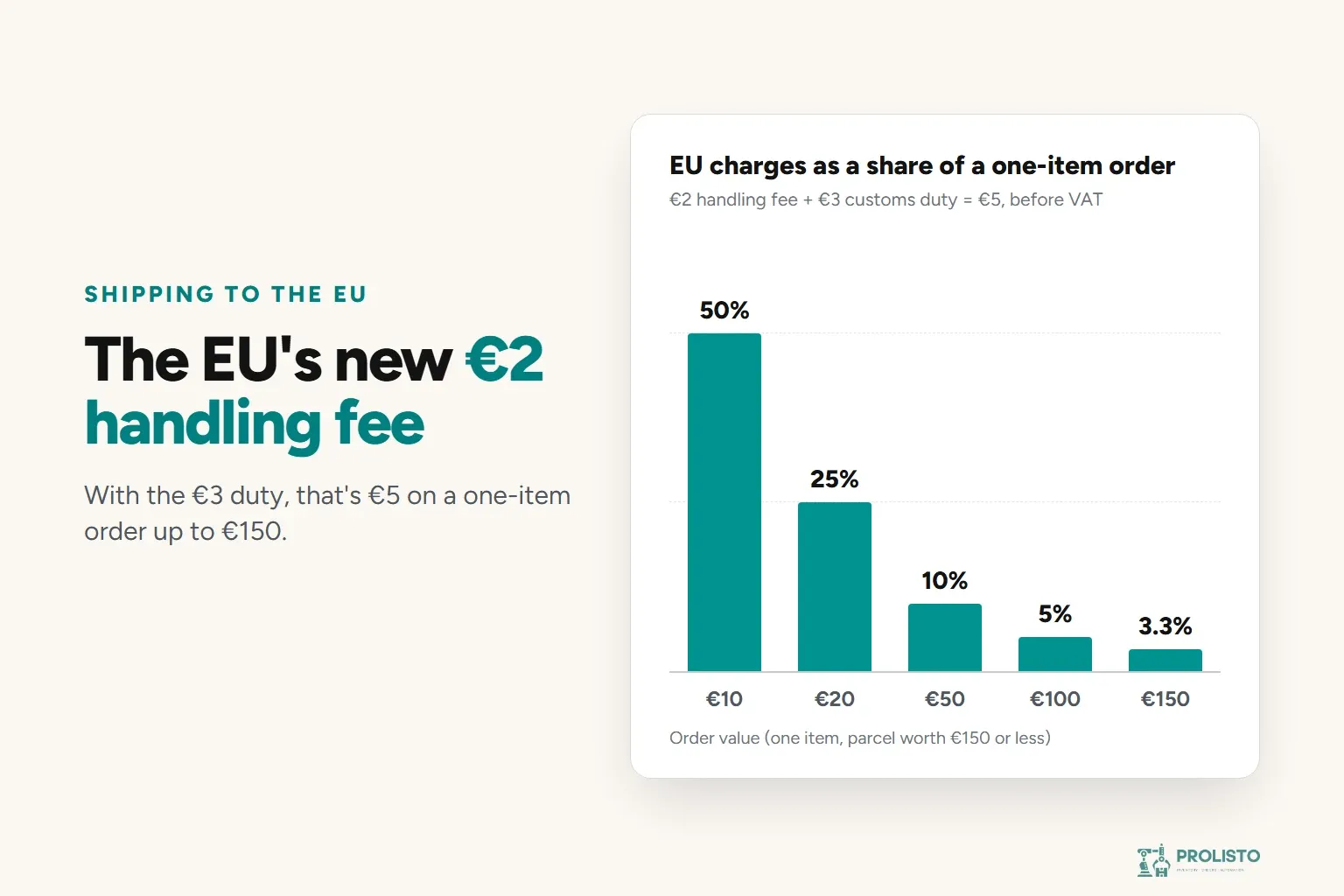
For a parcel with one item, worth €150 or less, the two charges come to €5 before VAT. Because that's a flat amount, it weighs hardest on cheap items:
| Order value (one item) | Handling fee | Customs duty | Total | Share of the order |
|---|---|---|---|---|
| €10 | €2 | €3 | €5 | 50% |
| €20 | €2 | €3 | €5 | 25% |
| €50 | €2 | €3 | €5 | 10% |
| €100 | €2 | €3 | €5 | 5% |
| €150 | €2 | €3 | €5 | 3.3% |
| €200 | €2 | Normal duty for the goods | €2 plus duty | Depends on the goods |
All figures exclude VAT. If you sell books, games, music or other low-priced items into the EU, these charges can now be bigger than your margin on a single item.
What counts as an "item"?
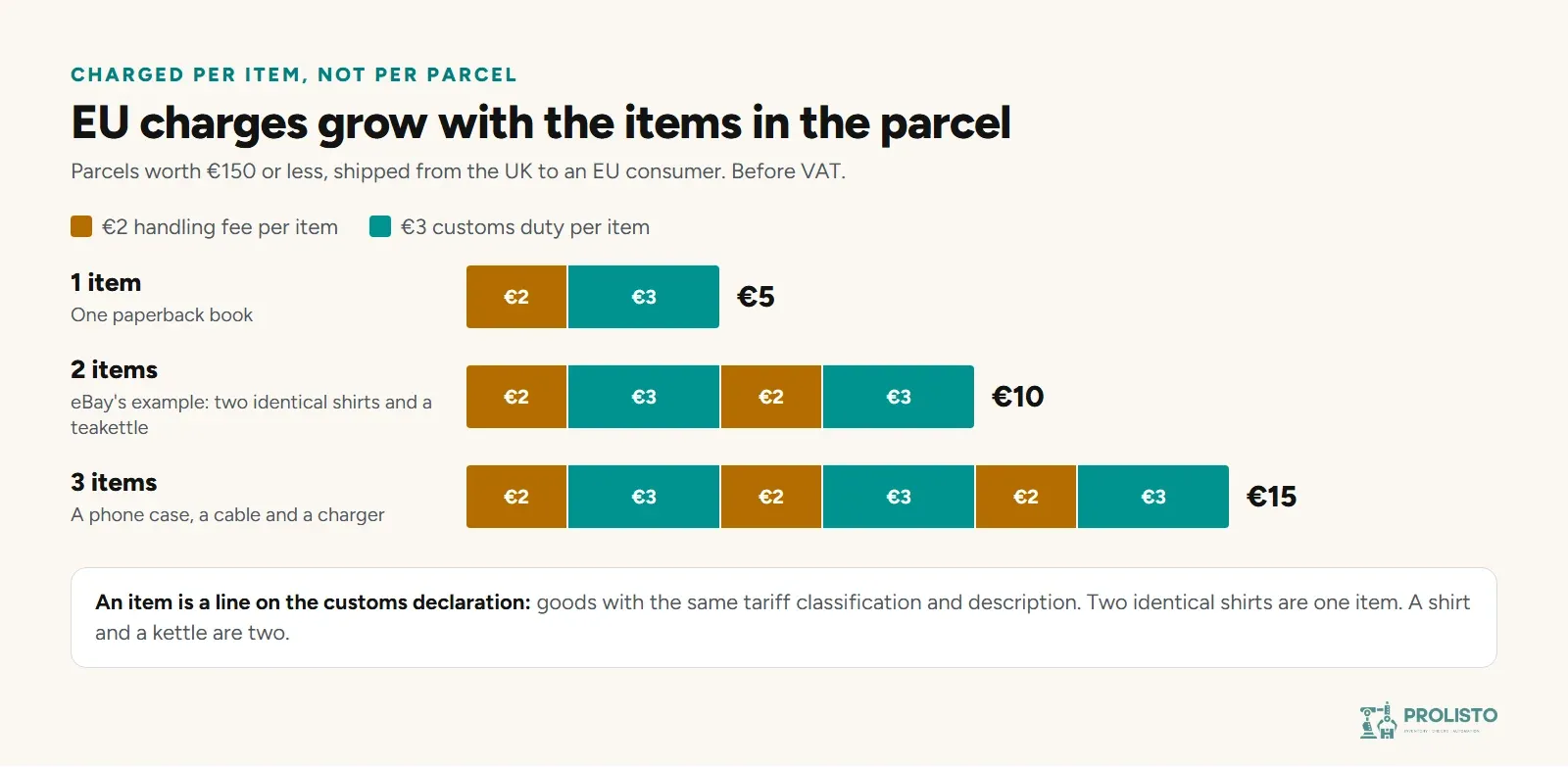
Not every product in the parcel. An item is one line on the customs declaration: goods that share the same tariff classification and description (and origin, where that's declared). Both the €2 fee and the €3 duty are charged per line, however many units are on it.
eBay's own example: a parcel with two identical shirts and a teakettle has two items, the shirts and the kettle. The handling fee is €4. If the parcel is worth €150 or less, the €3 duty applies to each item as well, so the charges come to €10.
That's why accurate item descriptions and classifications matter. Identical goods described the same way share one line. Describe them differently and they can become separate items, each charged on its own.
Who pays the €2 fee?
Under the Commission's guidance, the fee is owed by whoever declares the goods to customs, which can be the platform, the seller, the carrier, or an agent. In practice, how it reaches you depends on how the order is shipped:
- eBay International Shipping: eBay says buyers pay applicable import charges at checkout, so the fee is part of what the buyer sees before they pay.
- Your own carrier: eBay tells sellers to check with their shipping provider. eBay also warns buyers that they may be charged import fees on delivery if the seller hasn't already paid the carrier.
A buyer who's asked for unexpected charges at the door may refuse the parcel or leave negative feedback, even when the charge isn't your fault. So ask each carrier you use for EU orders two questions: does it charge the €2 fee and €3 duty to you or to the buyer, and does it add its own handling charge on top?
What UK sellers can do
The charges are the same for every seller shipping from outside the EU, so the aim is to stop them surprising you or your buyers:
- Check your EU prices on low-value items. On a €10 item, €5 of charges is a real cost to someone. Decide whether it goes in your price, your postage, or the buyer's import charges.
- Say who pays in your listings. If the buyer may be charged on delivery, tell them before they buy.
- Encourage multiple items of the same product in one order. Identical goods described the same way can share one item line, so the charge doesn't multiply.
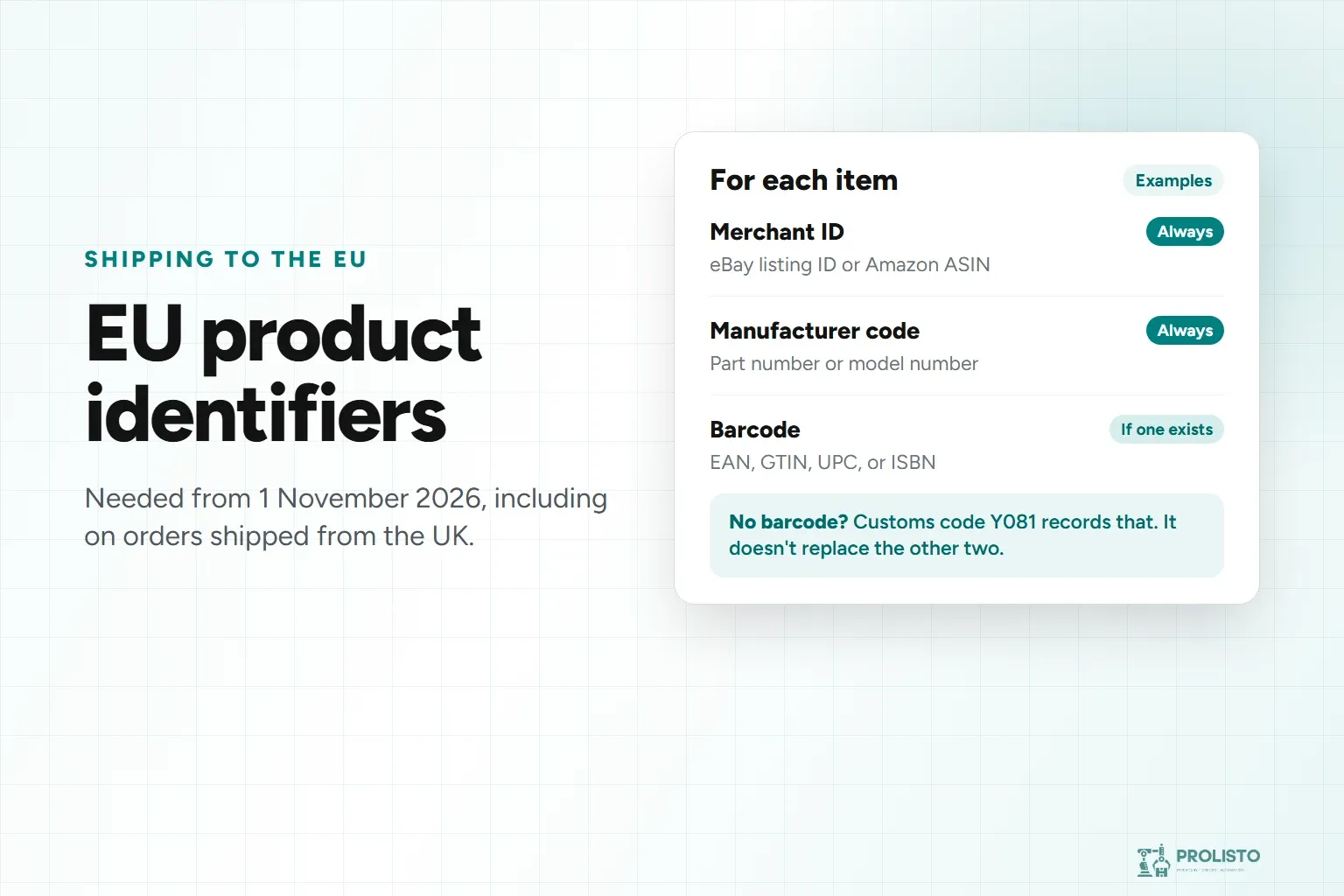
- Keep item details accurate. Descriptions, item specifics and product identifiers feed the customs data. Our guide to EU product identifiers explains the codes customs has needed since the same date.
- Review it before 1 July 2028. That's when the €3 duty ends and normal duty rates apply to every parcel instead.
For the wider picture on selling into Europe, see our guide to top European online marketplaces.
How Prolisto helps
Prolisto doesn't change what EU customs charges, but it helps you get EU orders out with the right data and the right service:
- Customs data sent with every label. Prolisto sends item details and the EU product identifiers through Royal Mail (Click & Drop and ProShipping), DHL, Deutsche Post, Whistl, Amazon Buy Shipping, and CSV carriers with international services. Multi-carrier order fulfilment.
- The right service for EU orders, automatically. Courier rules pick the service by marketplace, order value, weight and destination, so EU orders can go by the service you've chosen for them without deciding by hand.
- Prices that cover the cost. Repricing rules keep every price between a floor and a ceiling you set, so you can build your EU costs into the floor. Automated pricing.
If EU orders are a growing part of your business, book a demo and we'll show you how Prolisto handles them.
Run your eBay and Amazon business in one place
Start free trialBy Prolisto Team · Published 11 November 2026
The Prolisto team builds listing, pricing, inventory and fulfilment tools for eBay, Amazon and WooCommerce sellers, and writes about what works on the marketplaces.